
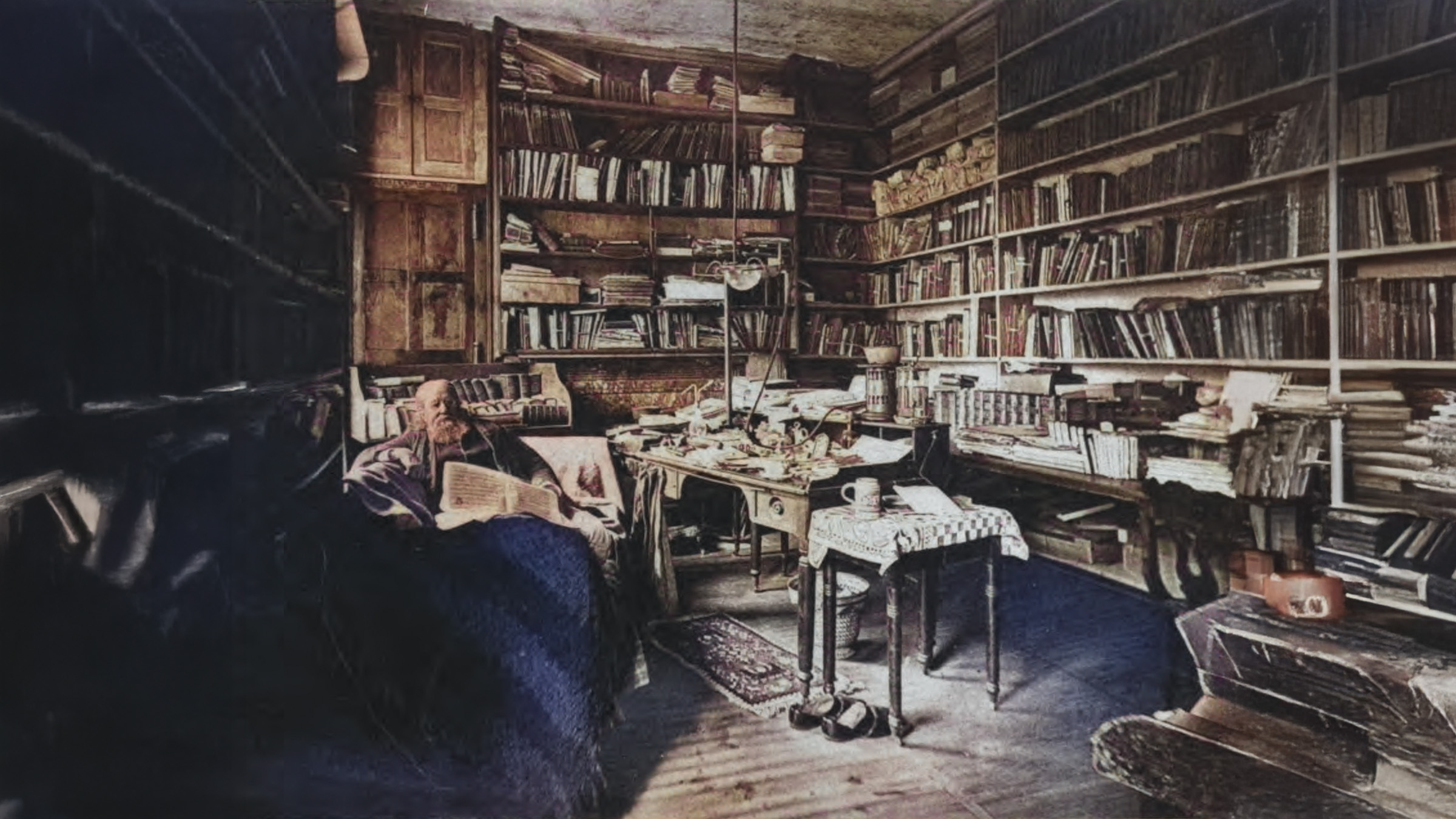
There are moments when a photograph does not simply capture an image; it captures a soul. As I sat gazing at the old photograph of Dr. Constantine Hering in his study, I felt an invisible thread pulling me across time, inviting me to step into his world — a world where silence spoke, where books breathed, and where every object seemed to hum with a quiet symphony of a life devoted to healing and wisdom.
This photograph, more than a century old, is not merely a record of a room and its occupant. It is a rare and precious portal into the final chapter of a life that shaped the course of homeopathy forever. Captured likely in the late 1870s, just a few years before his passing in 1880, this image freezes a moment in Dr. Hering’s later years — a time when physical strength may have diminished, but the fire of intellect and purpose burned as brightly as ever. The very atmosphere of the photograph carries the softness of age, the patience of a mind that no longer races toward ambition but walks gently with wisdom.
It is said that as Dr. Hering aged, he withdrew more deeply into his work, finding in his books and manuscripts not isolation but deep companionship. Despite the frailty that inevitably came with his years, he remained immersed in his scholarly pursuits, continuing to write, edit, and refine his lifelong contributions to homeopathic medicine. His surroundings in this photograph reflect not the decay of age, but the richness of a harvest gathered over decades of laborious cultivation.
At the time this photograph was likely taken, Dr. Hering was finalizing what would become his crowning literary achievement — “The Guiding Symptoms of Our Materia Medica.” It was an ambitious, monumental effort to distill and organize the vast sea of symptomatology accumulated through clinical experience and provings into a coherent, usable form for generations to come. Even in the face of his failing health, he dedicated his last energies to this sacred task. The cluttered tables, the scattered papers, the books opened at curious angles — all whisper of a mind still sorting, weighing, perfecting the work that would outlive him.
Born in 1800 in Oschatz, Saxony, Dr. Hering had been destined, in his youth, for a conventional career in surgery. Yet a fateful encounter with homeopathy during his university studies changed the entire course of his life — and, through him, the future of healing in America. Crossing oceans, facing hardships, enduring skepticism, he planted the seeds of homeopathy in the New World with courage, scholarship, and an unshakable belief in the principles laid down by Hahnemann.
Now, in the twilight of his years, seated in this quiet study, we see not the young revolutionary, but the seasoned master — surrounded not by applause or accolades, but by the true companions of his journey: his books, his papers, his dreams, and his indomitable spirit.
In the dim, gentle light, he reclines, draped in a thick, warm blanket, as if cocooned in the soft arms of time itself. His beard, long and flowing, merges into the folds of the fabric, creating the image of a wise sage resting in a sanctuary of thought. A large book rests in his hand, open but relaxed, almost as if it has become a part of him. His eyes, though aged, seem alive, gazing into the pages not with the urgency of ambition, but with the serene companionship of an old friend revisiting a lifelong conversation.
Around him, the study breathes — a living entity built from countless hours of reading, writing, healing, and dreaming. The walls are covered from floor to ceiling with books, their spines forming an intricate mosaic of human knowledge and curiosity. Each book, worn yet proud, seems to hold not just information but a memory, a moment of discovery, a flicker of inspiration that once crossed Dr. Hering’s mind.
Above the low shelves, more books are stacked horizontally, carefully placed wherever space permitted. The weight of these volumes presses down gently on the room, creating an atmosphere that is not heavy, but profound — a sacred heaviness, the kind that invites one to slow down, to listen, to think.
The wooden cabinets with closed doors hint at secrets kept safe — perhaps unfinished manuscripts, old letters, carefully preserved vials of remedies, precious instruments of a physician’s quiet craft. Each cabinet stands like a silent guardian of mysteries only partially revealed.
The tables in the center of the room are crowded yet comforting. Papers are scattered in organized chaos, each sheet bearing the imprint of a life that never truly ceased to work. There is a balance scale — delicate, intricate — hinting at the meticulous care with which homeopathic preparations were handled. There are writing instruments — ink pots, pens, perhaps even blotting paper — standing ready, as if awaiting his next thought, his next discovery.
On the table closest to him, a simple mug rests, its presence touching me more deeply than I could explain. In that plain mug, I saw the humanity behind the greatness — a man who needed warmth, who sipped tea or coffee during long nights of reading, thinking, and perhaps remembering the patients who had passed through his compassionate hands.
The rugs on the wooden floor, simple yet beautifully worn, carry the faint marks of countless steps taken in thought. At his feet, a pair of house slippers lies quietly, speaking of comfort, of home, of a life lived deeply within these walls.
Above, the ceiling shows the passage of time — the slight sagging, the stains of age — and yet it stands firm, holding the atmosphere together like the final movement of a symphony played with hushed reverence.
The more I looked, the more I felt that this was not just a study. It was a temple of learning, a sanctuary of healing, and a repository of human spirit. Each item — every book, every scrap of paper, every humble object — was a note in the silent symphony that played continuously in this room, even after Dr. Hering’s physical presence had faded into the fabric of history.
As I imagined myself stepping closer, I could almost hear the gentle creaking of the floorboards beneath my feet, the faint rustle of paper touched by a passing breeze. I could sense the faint aroma of old leather bindings, aged wood, and the subtle, familiar scent of well-worn books — a fragrance that only true libraries and old studies possess. It was as if the very air held whispers of unfinished thoughts, lingering hopes, and the quiet energy of a mind forever engaged in dialogue with the unseen.
I imagined myself pulling out a book from the shelf, feeling its weight, opening it carefully to find handwritten notes in the margins — a glimpse into the living mind of a man who sought not just to treat diseases but to understand life itself. Perhaps here, in these pages, were the seeds of the Guiding Symptoms, the quiet thoughts that would eventually blossom into guidance for countless homeopaths across the globe. Each notation, each underline, each tiny correction in the margins felt like the pulse of a life that refused to be ordinary.
The photograph does not show us movement, and yet, in a strange and tender way, it feels alive. It is not difficult to imagine Dr. Hering shifting slightly under his blanket, turning a page with slow reverence, or closing his eyes momentarily to summon a memory from decades past. This was no ordinary old man slipping into the silence of forgetfulness. This was a mind that carried within it the memories of hundreds of cures, the echoes of thousands of questions, the footsteps of a movement that had crossed oceans because of his will.
And yet, there is no grandeur here. No gleaming trophies, no ornate displays of success. Only the quiet dignity of service without expectation, labor without vanity, devotion without demand for recognition. It is humbling to see how a man who had achieved so much — who could have laid claim to titles and honors — chose instead to wrap himself in simplicity, allowing his surroundings to mirror the values that guided his heart.
I paused again to study the center table, noting how books and teacups and papers mingled freely without rigid separation. Here was a living proof that creativity and scholarship thrive not in sterile perfection but in the warmth of organized chaos. Perhaps there is a lesson in that: that true learning is never neatly contained, but flows naturally, touching all aspects of life, unafraid of disorder because it knows its own deeper order.
Somewhere near the corner, I noticed what seemed to be a small pile of manuscripts tied with string — a modest bundle of papers, but one that might have held dreams spanning continents and decades. Was this perhaps a draft of a new lecture he had intended to deliver? Notes for the next volume of his work? An unfinished letter to a student or a fellow physician? We will never know. But their silent presence speaks volumes. Even in his last years, even as his body aged and slowed, his mind had not retired from the great dialogue between healer and humanity.
Looking at the photograph again, I realized how fitting it was that there were no clear boundaries between the personal and the professional in this space. In Dr. Hering’s study, life and work had fused into one seamless fabric. The books were not trophies of learning; they were companions. The papers were not burdens; they were invitations to continue seeking. The quietness was not emptiness; it was fullness — fullness of thought, fullness of love for the art and science he had served so faithfully.
I imagined the winters that must have passed in that room, the cold winds tapping at the windowpanes while he sat, wrapped in that heavy blanket, pen in hand, dipping into ink, his mind traveling far beyond the walls that enclosed him. Perhaps there were nights when exhaustion overtook him mid-sentence, when the candle burned low and flickered out while he dreamt with open eyes. Yet even these moments, even these silent retreats into sleep, were part of the grand symphony being played out quietly within these walls.
In the presence of this image, I found myself thinking of time — not as a ruthless destroyer, but as a gentle preserver. Time had softened the edges of the room, faded the fabrics, dulled the wood, and yet it had preserved the essence. The soul of the study remained intact, a testament to the enduring power of a life lived with purpose and love.
And it struck me then that Dr. Hering, in his later years, embodied something that few people ever achieve — he became his work, and his work became him. There was no separation. His life was his message. His study was his temple. His every breath contributed, directly or indirectly, to the edifice of healing that he left behind for us.
The more I surrendered myself to this moment, the more I realized that this photograph was not merely about Dr. Hering’s physical presence. It was a portrait of devotion itself. It was the visible residue of an invisible journey — the journey of a man who had walked with sickness, with suffering, with science, and with spirit, carrying the lamp of inquiry into the dark and tangled forests of disease and human despair.
I found myself imagining the echoes of conversations that must have filled this room — conversations with students, fellow physicians, curious laypersons who came seeking understanding. Maybe, on some evenings, a young physician would have sat nervously across from Dr. Hering, asking questions, receiving not only words but the weight of a tradition handed down through generations. Maybe here, over a cluttered desk, dreams were born, and futures were shaped.
The more I imagined, the more the silence of the room seemed to pulse with life. It was not the silence of absence, but of presence — the kind of silence that fills cathedrals, ancient libraries, and sacred groves. A silence that holds memory, meaning, and mystery in its arms. A silence that invites you not just to look, but to listen.
And what does it say, this silence?
It says that true greatness is not loud. It says that the most enduring legacies are not built in palaces but in quiet rooms. It says that healing is not a conquest but a calling, not a profession but a pilgrimage.
In that quiet symphony, I could hear faint strains of music — not made by instruments, but by paper, ink, wood, wool, and thought. The music of diligence. The music of care. The music of one human being reaching across suffering to touch another with kindness, science, and hope.
There, in that room, past and future were woven together. The past of all that Dr. Hering had learned — from Hahnemann, from his teachers, from his patients — and the future that his books would carry forward, long after he had laid down his pen for the last time. It is a rare soul who can build bridges between centuries with nothing more than words, trust, and unwavering dedication.
I thought about The Guiding Symptoms again — that great, unfinished masterpiece. Dr. Hering had poured the twilight of his life into that monumental work, aiming to create not just a catalogue of symptoms but a living guide for future generations of homeopaths. Each remedy he recorded was not merely a chemical profile; it was a human story distilled into language. Each line was a whisper from a patient he had cared for, a provers’ subtle change carefully noted, a detail preserved so that others might heal more wisely.
The sheer immensity of that task humbles me even now. Without computers, without databases, without assistants humming in the background, he had set himself to organize the chaotic, scattered universe of homeopathic symptoms into a galaxy of meaning and usability. And here, in this room, we see the battlefields of that endeavor — the crumpled papers, the exhausted books, the long nights visible only by their quiet aftermath.
When I look closer at his face in the photograph, I do not see sadness. I see serenity. A peace that comes not from comfort, but from completion — the peace of a man who has given his best to the world, without holding anything back. His blanket is not just a protection against the chill of the room; it is a cloak woven from thousands of hours of love, pain, effort, and learning.
This study is not a monument built by admirers after his death. It is the real, living space where Dr. Hering faced himself every day. His struggles, his doubts, his moments of illumination — they all lived here first, quietly, before they became part of the external world of medicine.
And in that understanding, I felt a deep and aching reverence.
A reverence not only for Dr. Hering as a man, but for the silent, sacred labor that true healing demands from those who truly seek to heal.
A reverence for every physician who spends their nights studying while the world sleeps.
A reverence for every mind that sacrifices ease for understanding, every heart that bears the burden of caring without ever expecting applause.
I sat back, allowing my eyes to soften, letting the image blur slightly, almost as if inviting it to dissolve into memory. And yet, it stayed — rooted, real, insistent — a quiet reminder that some lives do not vanish; they continue to whisper across the corridors of time.
Even now, more than a century later, I can feel the hum of that room. It lives on, not because of the wood or paper, but because of the spirit that filled it. Dr. Hering’s study is no longer bounded by the four walls it once inhabited. It has become a part of the greater homeopathy timeline — an invisible yet palpable landmark in the vast map of human endeavor toward gentler healing, deeper understanding, and compassionate science.
As I reflect, I realize that the silent symphony of Dr. Hering’s study is not merely about nostalgia. It is about continuity. About the unbroken line of seekers and healers who, knowingly or unknowingly, draw strength from rooms like this, from lives like his, from works like The Guiding Symptoms.
It is an inheritance not measured in wealth, but in will.
The will to continue learning when it is easier to rest.
The will to continue caring when it is easier to detach.
The will to continue questioning when it is easier to accept what is comfortable.
I imagine, sometimes, young students — perhaps today, perhaps tomorrow — who will never see this photograph, who will never step into such a room, but who will still, in some quiet moment of their own, feel the pulse of this symphony beating in their hearts. They, too, will sit late into the night, poring over cases, struggling to understand, daring to believe that healing can be more humane, more profound, more true.
And when they do, whether they know it or not, they will be answering the same call that Dr. Hering answered in his youth — the call that led him across continents, across hardships, across a lifetime of service.
The call to heal, not merely with remedies, but with reverence.
In my mind’s eye, I see him one last time — the old man with the flowing beard, the thick blanket, the open book, the mind that refused to be conquered by time.
I see the glint of the spectacles perched low on his nose.
I see the half-finished cup of tea, still warm with purpose.
I see the pen lying beside the paper, waiting patiently for the next thought, the next sentence, the next offering to the future.
And then, I let the image settle deep into my heart — a treasure placed gently into the archive of memory, alongside all the other moments that remind me why we strive, why we heal, why we seek meaning even in the smallest corners of the world.
Dr. Hering’s study remains. His books remain. His spirit remains.
And somewhere, in the silent spaces between our own busy lives, his symphony continues to play — softly, persistently, eternally.