
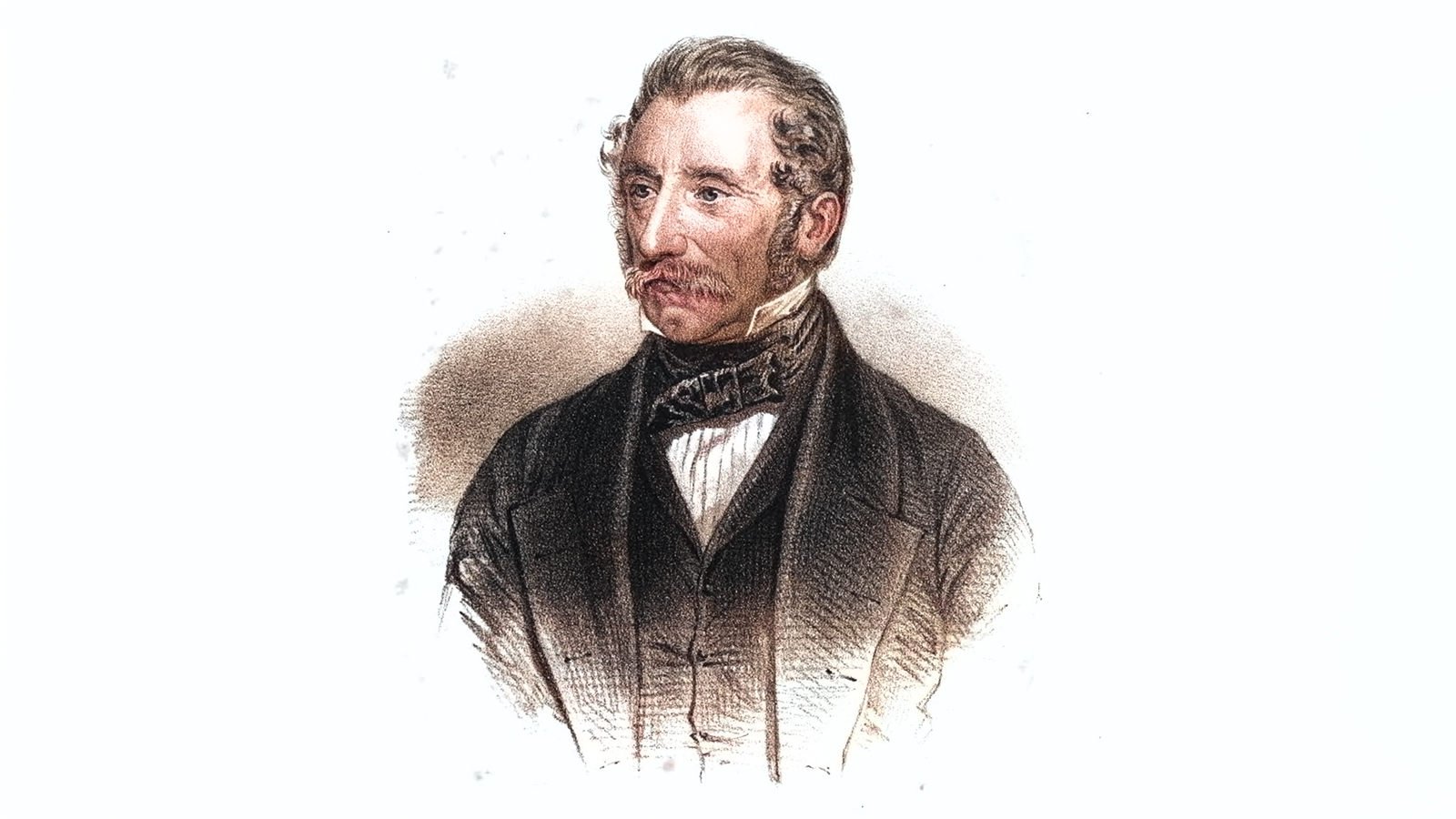
There are moments in history that look small from the outside, yet they quietly change the course of generations. One such moment happened in the summer of 1835, when a curious, well-travelled doctor named Johann Martin Honigberger knocked on the door of Dr. Samuel Hahnemann in Paris. That meeting, humble and warm, became a turning point—not only in Honigberger’s life, but also in the journey of homeopathy to India.
Honigberger was not an ordinary doctor. Born in 1795 in Kronstadt (now Brașov, Romania), he had already travelled across the Middle East, Egypt, and parts of Asia, treating the sick in cities touched by plague and poverty. By the time he returned to Europe in 1834, he had seen the strengths and failures of many medical systems. Something inside him was restless—looking for deeper healing, more certainty, something that worked not just on the disease, but on the person as a whole.
It was during his travels in Russia that Honigberger first heard whispers about a new system of healing. People spoke of a German physician who had turned the medical world upside down—not with surgical knives or bitter pills, but with minute doses and a simple principle: “like cures like.” That man was Samuel Hahnemann, and his system was called homeopathy.
“In Russia, I had been already told of the prodigious effects of his new healing system,” Honigberger later wrote. These words were not just hearsay to him. They became a call. And so, when he found himself in Paris in 1835, he didn’t waste time. He walked the streets with a single goal in mind: to meet the master himself.
“At Paris, my steps were first directed towards the domicile of the father of Homœopathy, the celebrated Doctor Hahnemann.”
This wasn’t just a visit. It was a turning point. We can imagine Honigberger, dusty from travel, his mind full of questions, finally standing at the door of the old man who had dared to challenge the medical establishment of Europe.
And what awaited him inside?
“The magnanimous old man and his lovely young wife received me in the most friendly manner…”
The tone is soft, almost personal. Hahnemann—by then nearly 80 years old—was no distant academic. He welcomed Honigberger like a seeker at the threshold of something sacred. And standing beside him was Mélanie Hahnemann, graceful, intelligent, a strong supporter of her husband’s work. This warmth, this openness, made an impact.
“…the open and good-natured Homœopathist made many interesting revelations to me respecting his new method of curing.”
Can you imagine the scene? Two doctors, face to face. One with a world of experience, the other with a world of questions. In that room, medicine became mentorship. Healing became human.
It wasn’t just philosophy that Hahnemann shared. He gave practical guidance. He directed Honigberger to Dr. Lehman, his trusted apothecary in Köthen, where Hahnemann had lived and worked for many years before settling in Paris. If Honigberger was to carry homeopathy forward, he would need genuine, properly prepared remedies.
“According to Hahnemann’s advice, I introduced myself, at Köthen, to Doctor Lehman, from whom I bought a considerable quantity of homœopathic medicines.”
He didn’t buy a few vials. He bought a considerable quantity. Why? Because he was preparing—not just to experiment with homeopathy, but to practice it seriously. To test it, to apply it, to use it on patients across seas and deserts, in places where even the idea of “homeopathy” was unheard of.
And then, Honigberger moved on. He travelled to Leipzig, Dresden, and Teplitz, attending the grand Congress where emperors and diplomats met. But in his heart, he was already carrying a different kind of power—the power to heal gently, to observe carefully, to treat like with like.
When he returned to India in 1838, he did not come as just another European doctor. He came as the first homeopath to step foot in Indian soil. And the rest, as they say, is history.
Honigberger’s return to India was not the return of a man carrying books—it was the arrival of a man carrying a legacy. Tucked in his medical chest were the medicines he had personally collected from Dr. Lehman in Köthen. But more than that, he carried the spirit of Hahnemann’s teaching, passed to him not through textbooks, but through human contact—conversation, trust, and shared purpose.
In Lahore, Honigberger resumed his medical work, now infused with this new healing philosophy. His most famous case would soon follow. The great Maharaja Ranjit Singh, ruler of the Sikh Empire, had lost his voice. He had paralysis of the vocal cords—a condition that many physicians had failed to cure. Honigberger gave him Dulcamara, a homeopathic remedy that he had acquired after studying Hahnemann’s materia medica.
The result? The Maharaja spoke again.
This was not just a clinical success. It was the birth of homeopathy in India. A German-speaking doctor, trained in classical European medicine, who had walked the streets of Paris to meet an old man named Hahnemann, now stood in a royal court in Punjab—introducing to India a system of healing based on subtle observation and individualisation.
But Honigberger never claimed perfection. He did not blindly follow. He remained a critical thinker, always testing what he had learned:
“I do not profess myself a votary of Hahnemann’s system.“
He admitted that infinitesimal doses did not always work. He felt that larger doses were sometimes needed, and that strict dietary restrictions were not always practical. He did not abandon Hahnemann’s teachings—but neither did he freeze them in time. Instead, he adapted them, tested them, and moulded them through experience. And that, perhaps, is the most honest way to honour any teacher.
To us, today’s homeopaths, this story offers more than nostalgia. It gives us direction.
We live in a time when homeopathy is often questioned, when evidence is demanded, and when faith is tested. In such times, we need to remember Honigberger—not because he followed Hahnemann word for word, but because he had the courage to seek him, to ask questions, and to apply what he learned with integrity.
He didn’t just practice homeopathy. He carried it across continents, through languages and cultures. He treated kings and commoners alike. He combined compassion with experimentation, discipline with flexibility, and science with human touch.
So the next time you doubt your place in this field…
The next time you feel the weight of modern medicine’s criticism…
The next time a patient walks into your clinic with eyes full of hope…
Remember this:
One man walked to Hahnemann’s doorstep in Paris.
And from there, he brought homeopathy to India.
Let us keep that journey alive—not just in stories, but in our prescriptions, our listening, our practice.
Let us walk again—not in the streets of Paris, but in our own minds, clinics, and classrooms—toward that same spirit of openness, learning, and healing.
“At Paris, my steps were first directed towards the domicile of the father of Homœopathy…”
And today, our steps must follow.